Guide for fiction podcasts
How to make clips from an audio drama or fiction podcast
Most clip advice assumes two people talking, a hot take and a face to put it on. An audio drama has none of that. It has a cast of voices, a score, a story that only pays off in order, and an audience that hates spoilers. You can still clip it. You just choose the scene differently.
The short answer
Clip a scene, not a line: one exchange, 45 to 90 seconds, taken from early in an episode so it raises a question without answering it. Show your cover art, big captions and something that moves with the voices, and keep away from AI art. Post a one-minute trailer for each new episode, and ask your cast to share it, because their followers are the people most likely to listen.
Shorts by Slice turns a long podcast or stream into captioned vertical clips. $14.99 a month. Your first video (we search the first hour) and first 2 clips are free, no card. After that, buy clips one at a time or take the plan, which you can cancel any time.
Try it free →Why fiction is harder to clip than a talk show
A talk show is made of moments that stand alone. Someone tells a story, someone says something sharp, and thirty seconds of it makes sense to a stranger. A drama is built the other way round. Every scene leans on the one before it, the best line usually only works because of what you already know, and the moment everyone remembers is often the twist you least want to give away.
Then there is the platform problem, which one creator put plainly:
“I don't know the platform and am unsure how I can capitalize on a video/image first platform with audio-only content.”
Both problems have workable answers. The first is about which scene you pick. The second is about what you put on screen while people listen.
Which scenes make a good clip
| Scene | Good clip? | Why |
|---|---|---|
| An argument between two characters | Yes | Conflict explains itself. You do not need to know who they are to pick a side. |
| The first line of a new mystery | Yes | It raises a question and stops. That is exactly what you want a stranger to feel. |
| A funny exchange | Yes | Comedy travels further than almost anything else, and it rarely spoils the plot. |
| A big sound design moment | Sometimes | Great in headphones, thin on a phone speaker. Add captions so the scene reads with the sound off. |
| A monologue | Sometimes | Only if it is short and the voice is strong. Trim it hard. |
| The twist or the ending | No | It spoils the episode for exactly the people you are trying to bring in. |
A useful test: play the clip to someone who has never heard the show. If they ask “what happens next?”, it works. If they ask “who is that?”, it needs a line of setup on screen, or a different scene.
What to show when there are no faces
Audio drama creators have tried most things, and the ones that keep coming up are simple. One put it in a single line:
“Social Media - post with images or trailers.”
Another builds a short trailer for every episode as an audiogram:
“The only videos I do are audiograms. I build trailers for each of my upcoming episodes (1 min long) and post those.”
If you work with artists, there is a richer option:
“You can collab with your artists and do animatics of funny, intense, or whatever moments of your audio drama to post on tiktok”
One warning that is particular to this world. Many audio drama creators and listeners are artists, writers and voice actors, and AI art is a sore point. A creator answering a newcomer said so directly:
“the majority of audiodrama creators look down on ALL AI use, even art”
So use what is yours: the cover art, the cast’s own photos if they want to be seen, commissioned art, and the words themselves as big type. In Slice the 47 audio templates are drawn from exactly those things, your words, your cover and the sound of the voices, with nothing generated. Our guide to audio podcasts on video shows sixteen of them on one real episode.
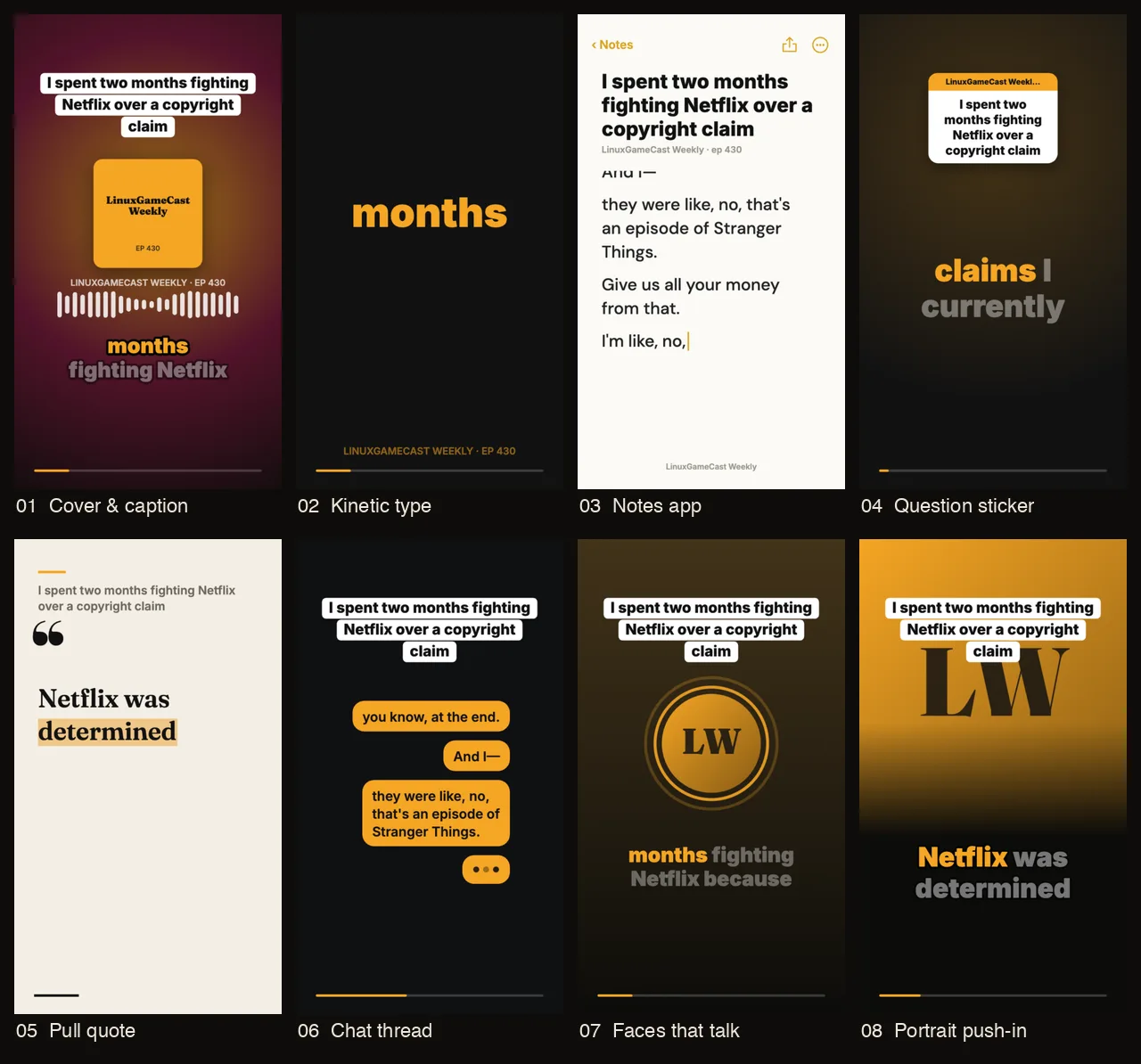
Trailers or scene clips?
Do both, for different jobs. A trailer is made for the feed and for trailer swaps with other shows, which creators in r/audiodrama call the most reliable way to find new listeners. A scene clip is made for social apps, where it reminds people who already listen that a new episode is out, and now and then reaches someone new. One creator who posts on both Instagram and TikTok added the point that matters most if you have a cast:
“If they’re willing to share and interact with the content, it can help those platforms grow a little faster since they push it out to their network as well.”
Send each actor the clip with their scene in it, already captioned and ready to post. Most will share a finished clip. Very few will make their own. Our guide to clips guests will share works the same way for a cast.
Audio drama to clips in Slice, step by step
- Upload the episode, or the finished scene
MP3, M4A, WAV, OGG or FLAC. Upload the full mix with music and effects, not the dialogue stem, so the clip sounds like the show.
- Ask for the kind of scene you want
On the episode page, finish the sentence “Find me clips about…” with something like “an argument between the two leads” or “the first time we hear the voice in the walls”.
- Trim to the scene, not the line
Start a beat before the first line and stop on the cliffhanger. Clips run 30 seconds to 2:30.
- Name the voices
In Show & people, match each voice to the character’s name, and add your cover art so every template carries the show.
- Pick a look that fits the genre, then export
A chat thread for a two-hander, big type for horror, the cover with a waveform for anything with a lot of sound design.
Slice finds dialogue that stands on its own, so it tends to suggest exchanges rather than sound design. Listen to each suggestion with the question in mind: does it make a stranger want the next scene, or does it give the next scene away?
Questions
Do short clips work for audio drama?
Less as a way to find strangers than as a reminder for people who already know the show, going by what creators report. Trailer swaps with other shows and word of mouth still do most of the finding. Clips are cheap to make once the episode exists, so they are worth posting, but keep your expectations modest.
How do I avoid spoilers in a clip?
Clip from the first act of an episode, or from the first episode of a season. Pick a scene that raises a question rather than answers one, and stop before the answer.
What should the video show if the show is audio only?
Your cover art, big captions of the lines, and something that moves with the voices. Fan art and animatics are lovely if you have them and the artist agrees. Avoid AI-generated art: many listeners and fellow creators in the audio drama world will hold it against you.
How long should an audio drama clip be?
Long enough for one exchange to land, usually 45 to 90 seconds. A one-minute trailer per episode is a common habit among creators.
Can I use the music from my show in clips?
Only if your licence covers social video. Library and commissioned music often allows it, but check, because TikTok, Instagram and YouTube all match audio automatically.
Get The Cut
More guides
- How to turn an audio podcast into video clips
- How to write the first line of a clip
- How long should a podcast clip be?
- Free MP3 to video
Example audio on this page: LinuxGameCast Weekly 430, CC BY-SA 4.0.