Guide for podcasters
How to write the first line of a podcast clip
You found a great moment. You posted it. It got a few hundred views and nobody followed the show. Very often the moment was fine and the first two seconds were the problem: a “so, anyway”, a pause, a wide shot of two people waiting to talk. This is about fixing those two seconds.
The short answer
Start the cut on the line that makes someone think “wait, what?”, not on the run-up to it. Put a short title across the top that says what the clip is about in the speaker’s own terms, keep it up for three to five seconds, and make sure the clip pays it off. Cut the ums and pauses from the opening; they cost you more there than anywhere else.
Shorts by Slice turns a long podcast or stream into captioned vertical clips. $14.99 a month. Your first video and first 3 clips are free, no card. After that it's one plan, and you can cancel any time.
Try it free →A clip has two first lines
There is the one you hear and the one you read. The heard one is wherever you started the cut. The read one is the title across the top of the frame, often called the hook title. On a phone with the sound off, which is how a lot of people meet your clip, the read one is all they get.
They do different jobs. The spoken line has to sound like the middle of something worth hearing. The title has to tell a stranger, in about a second, what this is and why it is for them. When the spoken opening is weak, a strong title can carry the first few seconds until the speaker gets going. When both are weak, the clip is over before it starts.
Four real clips, and the words they open on
We ran a 20-minute stretch of The Impodcast, Episode 1 (CC BY 4.0) through Slice and changed nothing. These are the four clips it found, the titles it gave them, and the first words each one actually opens on:
| Hook title | What is said first | Length | Why the title works |
|---|---|---|---|
| “How do you hit a goal you never named?” | “And I think a lot of people, um…” | 41 s | A question |
| “That one guy in the group who isn’t happy for you” | “It’s like um. you’ll be in a group and someone has…” | 44 s | A character everyone knows |
| “You can’t compare yourself to 7 billion people” | “This person’s getting more likes than me.…” | 42 s | A number |
| “You didn’t even know Wi-Fi existed 30 minutes ago” | “And um I think I heard Louis C.K. talk about it…” | 44 s | An odd detail |
Look at the second column. Three of the four open on “and”, “um” or “it’s like”. That is normal. People do not speak in clean first lines, and any tool that cuts on sentence boundaries will catch the warm-up. The titles hold up much better, because each one is the most interesting thing in the clip said plainly.
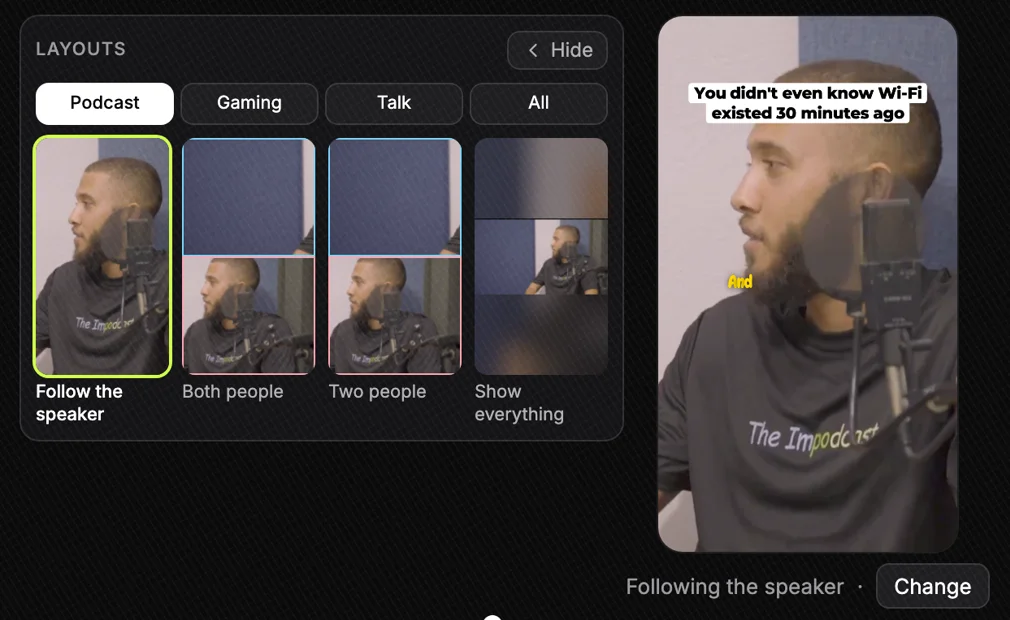
So the fix for these four is the same: keep the title, and drag the start of each clip forward to the first word that matters. On the Wi-Fi clip that means cutting “And um I think I heard” and starting on the comedian’s point. On the comparison clip the opening is already good: “This person’s getting more likes than me” is the problem, said in the voice of someone who has it.
Where to start the cut
The most common advice in podcasting threads is also the most useful: start mid-sentence, on the line with the charge in it, and lose the setup.
“the mid-sentence start tip changed everything for me when I first tried it, people scroll past the setup every single time”
The second most useful thing is to cut the air out of the opening. A pause that is fine in a full episode feels like a dead clip in the first second of a short one.
“went back and tightened a 35-second moment to 18 and it went from feeling kinda boring to actually snappy”
A few tests for the first line you hear:
- Does it make sense to someone who heard nothing before it? If it starts with “so that’s why”, it needs the thing before “so”.
- Is it the speaker’s strongest sentence, or the one before it? Usually you can lose one sentence of run-up.
- Is there a pause in the first second? Trim it. The first second is the most expensive second in the clip.
- Does it start on a laugh with no joke? Back up to the line that caused it, or start after.
Five patterns for the hook title
The four clips above happen to cover most of what works. None of these is a formula; they are ways of saying what the clip is about so that a stranger cares.
| Pattern | Example | Use it when |
|---|---|---|
| The question the clip answers | “How do you hit a goal you never named?” | The clip is an explanation or advice. |
| The person everyone knows | “That one guy in the group who isn’t happy for you” | The clip is a story about a type of person. |
| The number | “You can’t compare yourself to 7 billion people” | There is a real figure, a count or a scale in what is said. |
| The odd detail | “You didn’t even know Wi-Fi existed 30 minutes ago” | There is one strange, specific line that makes the point. |
| The claim | Say the guest’s opinion in their words | The clip is someone taking a side. |
And what tends to fall flat:
- “Episode 47 highlights” or the show name alone. Nobody scrolling cares yet.
- “You won’t believe this” and other titles that could sit on any clip.
- A promise the clip doesn’t keep. If the title says “the one trick”, there had better be a trick.
- A full sentence that runs to three lines. If it does not fit in two short lines, cut words until it does.
How long the title should stay up
Long enough to read twice, then get out of the way so the captions and the speaker’s face have the frame. For six to eight words that is about three to five seconds. Some clips are better with the title up all the way through, for example a clip that is a list of answers to one question.
In Slice a new clip is cut with its title already on as the hook title, shown for the first 4 seconds. Under Hook you can rewrite it, pick 1, 2, 3, 4, 5, 8, 10 seconds or the whole clip, or turn it off. Keep it clear of the buttons and the caption bar of each app; our Shorts, Reels and TikTok safe zone tools show where.
The first line of the post text
The words under the video are a third first line, and the most wasted one. Do not repeat the hook title. Pick up where it left off: who said it, what episode it is from, and one reason to hear the rest. “Our guest on why naming the goal is the step everyone skips. Full episode: link in bio.” Our podcast clip captions guide goes further on post text.
Better first lines in Slice, step by step
- Upload the episode and let Slice find the clips
Each clip comes back with a title written from what is said in it, and that title is already on the clip as its hook title.
- Read the first five words of each clip
If they are “so”, “and”, “um” or a run-up to the point, drag the clip’s start to the first word that matters.
- Rewrite the hook title if it can be sharper
Open Hook in the clip editor. Keep it under about eight words, say it the way the speaker would, and promise only what the clip pays off.
- Choose how long it stays up
New clips show it for the first 4 seconds. You can pick 1, 2, 3, 4, 5, 8, 10 seconds, or keep it for the whole clip.
- Export and post with a matching first line of post text
The words under the post should start where the hook title left off, not repeat it.
Get the Slice Weekly
One free email every Friday: tools for creators and the best advice we found from people who make things.
Questions
What is a hook in a podcast clip?
The first one or two seconds: the line someone hears and the words they read on screen before deciding whether to keep watching. In a clip it is usually two things at once, where you start the cut and the title you put across the top.
Should a podcast clip start mid-sentence?
Often, yes. Start on the most charged line, not the run-up to it. If the sentence only makes sense with its first half, keep the first half and cut the filler before it instead.
How long should the hook title stay on screen?
Long enough to read twice: about three to five seconds for six to eight words. In Slice new clips keep it for the first 4 seconds, and you can choose anything from 1 to 10 seconds or the whole clip.
Can I use a question as a hook?
Yes, if the clip answers it. “How do you hit a goal you never named?” works because the next 40 seconds are the answer. A question the clip never answers feels like a trick.
Is clickbait bad for podcast clips?
A hook that promises more than the clip delivers gets people to stay for three seconds and leave annoyed. Be specific and true: the strangest real detail in the clip beats a made-up shock.