Guide for podcasters
How to pick the best moments from a podcast
Finding the clip is the whole job. Cutting a minute out of a finished episode takes two minutes; choosing which minute takes the afternoon. Here is how to choose, how long to make it, and the four moments we would post from a real 82-minute episode.
The short answer
Pick moments a stranger can follow with less than ten seconds of setup: a story with a turn, a clear opinion with its reason, a real disagreement. Start on the line that bites, end on the payoff, and keep most clips between 30 seconds and a minute and a half. An hour usually holds three to six of them. Use a transcript or a tool for the shortlist; make the final choice yourself.
What makes a podcast moment worth clipping
The test that cuts through most of it came from a podcaster in a thread about AI clippers picking the wrong moments:
“try one hard filter: if the moment needs more than 10 seconds of setup to make sense, reject it.”
Everything that passes it tends to be one of four things: a story with a turn (something happens, then something unexpected), an opinion with a reason (not just “I love this”, but why), a disagreement between the people talking, or a useful answer to a question people actually ask. What fails is the moment that is only funny if you heard the previous ten minutes.
And keep the two jobs apart:
“I’d separate “finding possible moments” from “deciding what deserves to become a clip.””
“But I wouldn’t outsource the final selection — that’s an editorial and taste decision.”
A real episode: the four moments from 82 minutes
We ran LinuxGameCast Weekly 430 (LinuxGameCast LLP, CC BY-SA 4.0) through Slice on 2 October 2026. It is a loose, funny conversation about games, the kind that is hard to clip. Slice listed four moments, 39 seconds after the transcript was ready. Here they are with the line each opens on and the note Slice wrote about why it works.
| Moment | Length | Opens on | Why it works (Slice’s note) |
|---|---|---|---|
| 1. The lady with the magic calligraphy books | 1:07 from 17 pieces | “So gyms have been closed. I'm a powerlifter. I have to get creative with my training.” | Complete self-contained story with a hard left turn — powerlifter pushes a stranger's car up a driveway and gets paid in cancer-curing calligraphy; the 'I thought they were Bibles' beat lands and the Matrix line closes it. |
| 2. I spent two months fighting Netflix over a copyright claim | 1:11 from 6 pieces | “Um, you gotta realize how many false claims I currently get on our YouTube channel, man, each month.” | Specific, verifiable first-person war story with a punchline — the claimed song came from YouTube's own audio library — ending on 'be happy to see you in court.' |
| 3. Twitch and YouTube are not your friends | 0:34 from 4 pieces | Strong language; not shown | Starts cold on the strongest line in the episode and builds to an actionable takeaway about direct funding; highly shareable for any creator audience. |
| 4. A $4 Android game slapped on Steam | 0:51 from 9 pieces | “The uh developer's solution was to fix this was to disable my firewall and antivirus.” | Opinionated review takedown with receipts — he bought the mobile version to check — plus the absurd 'disable your antivirus' dev support answer as a cold open. |
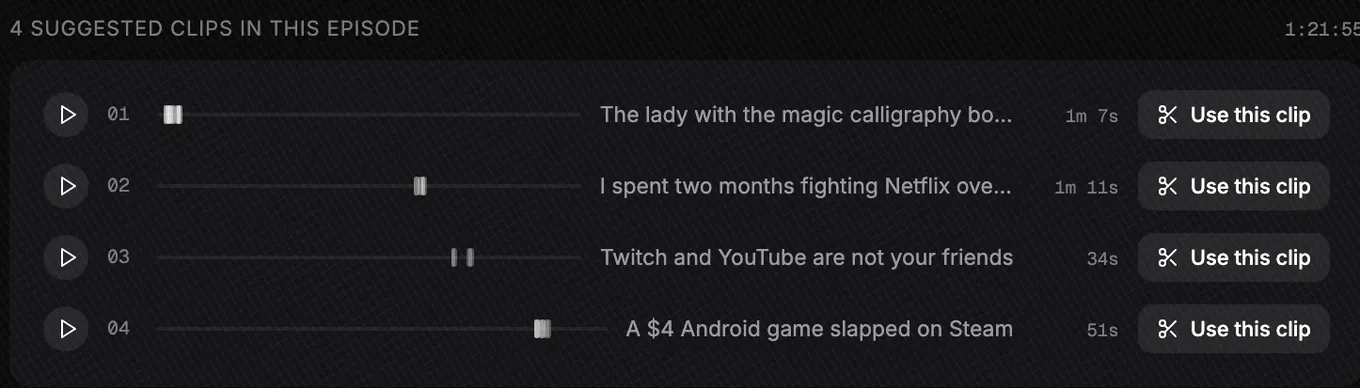
Notice the first one. The story is told over nearly three minutes, with asides; the clip is 1:07, built from 17 pieces, in the order they were said. That is the most useful thing a tool can do here, and the thing to check most carefully: the story must still be the story.
How long should podcast clips be?
As long as the moment, and every platform allows more than you need. What each one actually accepts, from the platforms’ own pages (read 2 October 2026 for our Social Video Specs 2026):
| Platform | Length | Worth knowing |
|---|---|---|
| YouTube Shorts | Up to 3 minutes, recorded or uploaded. No minimum. | Shorts longer than 1 minute with an active Content ID claim are blocked worldwide. |
| Instagram Reels | Up to 20 minutes, recorded and edited in the app. Reels over 3 minutes are not recommended to new audiences. | API uploads: 3 seconds to 15 minutes. Ads: up to 15 minutes. |
| TikTok | Up to 10 minutes through the API. In the app: not confirmed on an official page we could read; widely reported as 10 minutes recorded and up to 60 minutes uploaded. | TikTok's organic help pages load with JavaScript and could not be checked. The newsroom post on longer videos covers the older three-minute limit. |
| Facebook Reels (all video) | No minimum or maximum. | API publishing: 3 to 90 seconds. Feed video ads: up to 241 minutes. All uploads became Reels in September 2025. |
| 3 seconds (2 in the mobile app) to 15 minutes. | An older LinkedIn Pages article says 10 minutes. Video ads run up to 30 minutes. | |
| X (Twitter) Video post | Free: 140 seconds (2:20). Premium: up to 4 hours on x.com and iOS, 10 minutes on Android. | The API docs give different upload limits (20 minutes by default, 125 for Premium). X Help pages block automated reading, so these were read from X's own indexed pages. |
In practice the limits are not the constraint; attention is. The clips in our example ran 0:34 to 1:11. Slice keeps its clips between 30 seconds and two and a half minutes, long enough for a story, and inside every limit above except X’s 2:20 for free accounts.
How many clips are in an hour?
Fewer than people expect, by the accounts of the people who make them:
“If usable means it stands alone with a hook and a payoff for someone who has never heard the show, most 60 minute episodes have three to six, not twenty.”
“in a one one one interview-style show, 3 is typical.”
“posting 2 clips per episode. This is what I can mentally manage.”
Our 82-minute example gave four. That is normal, and it is a feature: a list of twenty is a list you have to go through again.
Can AI pick the best moments?
It can make the shortlist. Whether it can make the choice is the most argued question in r/podcasting’s clip threads, and plenty of podcasters have given up on it:
“I tried a few AI things out of curiosity, but it kept bringing me absolute trash like 90% of the time.”
“yeah the time you spend fixing AI output is basically the same time youd spend just doing it yourself in the first place”
Our view, as the people who make one: a tool should save you the scrubbing and show you why it picked each moment, and you should keep the last word. That is why Slice writes a note on each pick, lets you ask for moments about a topic, and shows where every piece comes from. If none of its picks is right, it says so rather than padding the list, and you can make a clip from any stretch of the transcript yourself.
And the cheapest method of all costs nothing: Marking moments when doing and editing listen through is the easiest thing for me since I'm already doing that.
How to pick the best moments, step by step
- Mark moments while you edit
You already listen to the whole episode once. Drop a marker, or write the time on paper, whenever something makes you react: a story, a laugh, a disagreement, a surprising number.
- Get a shortlist from the transcript
Read the transcript, or let a tool suggest candidates, to catch what you missed. Treat it as a shortlist of eight to ten, not the answer.
- Apply the 10-second test
If a stranger needs more than ten seconds of setup to follow the moment, drop it. What is left can open a clip cold.
- Find the first line that bites
Start the clip on the sentence that makes someone stay, not on the run-up to it. Cut the “so, um, anyway” at the front.
- End on the payoff, or just before it
Stop on the line that lands. If the point takes the whole episode, stop on the question and let the clip send people to the answer.
- Check it still means what was said
A clip that joins passages from different minutes must keep the order and the meaning. Your guest should recognise every word as theirs.
“mark clip-worthy moments with M while doing the main edit and actually name the markers like “strong hook”, “controversial”, “story”, etc.”
Get the Slice Weekly
One free email every Friday: tools for creators and the best advice we found from people who make things.
Questions
How long should podcast clips be?
Long enough for the moment to land: most good podcast clips run 30 seconds to a minute and a half. Slice’s clips run 30 to 150 seconds. YouTube Shorts take up to 3 minutes, and YouTube blocks Shorts over a minute that carry a Content ID claim, so keep clips with licensed music under a minute.
How many clips can you get from a one-hour podcast?
Usually three to six that stand on their own, by podcasters’ own counts. An interview show often gives three. Pulling twenty usually means counting filler.
What makes a good podcast clip?
It makes sense to someone who has never heard the show, it starts on a strong line, and something happens in it: a story with a turn, a clear opinion with a reason, a genuine disagreement, a useful answer.
Can AI find the best moments in a podcast?
It can find candidates quickly, and podcasters report it is wrong often. The working approach is to let a tool or a transcript give you a shortlist and keep the final choice yourself.
Should a clip start at the beginning of a story?
Only if the beginning is interesting. Often the better opening is the most surprising sentence, with just enough of the story after it to make sense.
Can a clip join two parts of an episode?
Yes, if it keeps the order and the meaning. In our example, one 1:07 clip was built from 17 short pieces of a story told over nearly three minutes. Never move words so someone seems to answer a question they did not.
More for podcasters
- How to grow a podcast with short clips: whether clips work, and a routine.
- How to turn an audio podcast into video clips
- Find the best moments in a long video with ChatGPT
- Social Video Specs 2026: sizes, lengths and safe zones for every platform.