Guide for podcasters
What to do when a podcast clip flops
You were sure about this one. The guest said something sharp, you cut it, captioned it, posted it on three apps, and it sat at a couple of hundred views. Before you decide the moment was bad, it is worth finding out which part of the clip let it down. Most of the time it is one fixable thing.
The short answer
Wait a few days, then look at where people left. If they swiped away in the first second or two, re-cut the opening and the hook title. If they stayed and then drifted off, cut it shorter so the point arrives sooner. If they watched but nobody followed, the clip worked and the post text did not. Post the changed version as a new post and keep the old one up.
Shorts by Slice turns a long podcast or stream into captioned vertical clips. $14.99 a month. Your first video (we search the first hour) and first 2 clips are free, no card. After that, buy clips one at a time or take the plan, which you can cancel any time.
Try it free →Read two numbers before you change anything
A view count on its own tells you very little. What you want to know is whether people left straight away or left later, because those are different problems with different fixes. Every big app now shows you some version of that.
| App | Where to look | What it tells you |
|---|---|---|
| YouTube Shorts | YouTube Studio, Analytics, Content tab, Shorts | How many people chose to view it, against how many swiped away |
| Instagram Reels | Insights on the reel | The skip rate: people who left in the first three seconds |
| TikTok | Analytics on the post | Average watch time, and how many watched to the end |
YouTube describes its own number plainly:
“Highlights the percentage of times that viewers viewed your Shorts versus swiped away.”
And Instagram’s, as it described it when the metric arrived:
“skip rate is the percentage of views from people who decided to skip your reel during those first 3 seconds”
TikTok does not publish a single number like that, but it does say what weighs most when it decides who sees a video, and watching time is in it:
“For most users, user interactions, which may include the time spent watching a video, are generally weighted more heavily than others.”
What none of them publishes is a target. You will find blog posts quoting a “good” skip rate, and none of those numbers comes from the platforms. The useful comparison is with your own clips. YouTube says as much, telling creators to
“avoid comparing each video against a viral hit”
Four kinds of flop, and the fix for each
| What the numbers say | What went wrong | What to change |
|---|---|---|
| Most people left in the first two seconds | The opening: a run-up, an “um”, a pause, a title nobody cares about yet | Move the start to the first line that matters. Rewrite the hook title. |
| People stayed a while, then drifted | Too long, or the payoff comes too late | Cut it shorter. End on the line that lands, not the laugh after it. |
| Few people saw it at all | It reached almost nobody, so there is nothing to judge yet | Wait longer, or post it on a second app. Judge it once it has been shown. |
| Good watching, no follows, no listens | The clip worked. The post gave no reason to go further | Say what the full episode is about in the post text and link it. |
The first row is by far the most common, and it is also the easiest to fix. The second is close behind. The third is not really a flop yet. The fourth is a separate problem that people often mistake for a bad clip:
“Curious what happened to listenership with 10M views of shorts?”
One clip, re-cut
Here is a real example. Slice cut this clip from The Impodcast, Episode 1 (CC BY 4.0). It is a good story, about a comedian’s bit where a plane gets Wi-Fi for the first time, it cuts out half an hour in, and someone is furious about losing a thing they did not know existed that morning. As cut, it runs 44 seconds and opens like this:
“And um I think I heard Louis C.K. talk about it um in one of his comedy bits where it’s like he gets on a plane…”
Read that as someone scrolling past. It takes about six seconds to reach anything happening. The story only starts at the flight attendant’s announcement, and the clip goes on past the punchline into a second example about teleporting, which is a fine idea but a different clip.
So the re-cut does three things:
- Start on the announcement. The new first words are “the flight attendant announces it’s the first time that they have Wi-Fi on that plane”. The setup was six and a half seconds; it is gone.
- End on the punchline. It now stops right after “you think it’s something that you’re losing”, at 25 seconds into the old clip. The teleport tangent can be its own clip.
- A shorter title. “You didn’t even know Wi-Fi existed 30 minutes ago” is the right idea but long, and it gives away the punchline. “Free Wi-Fi, gone in 30 minutes” sets up the story without telling it.
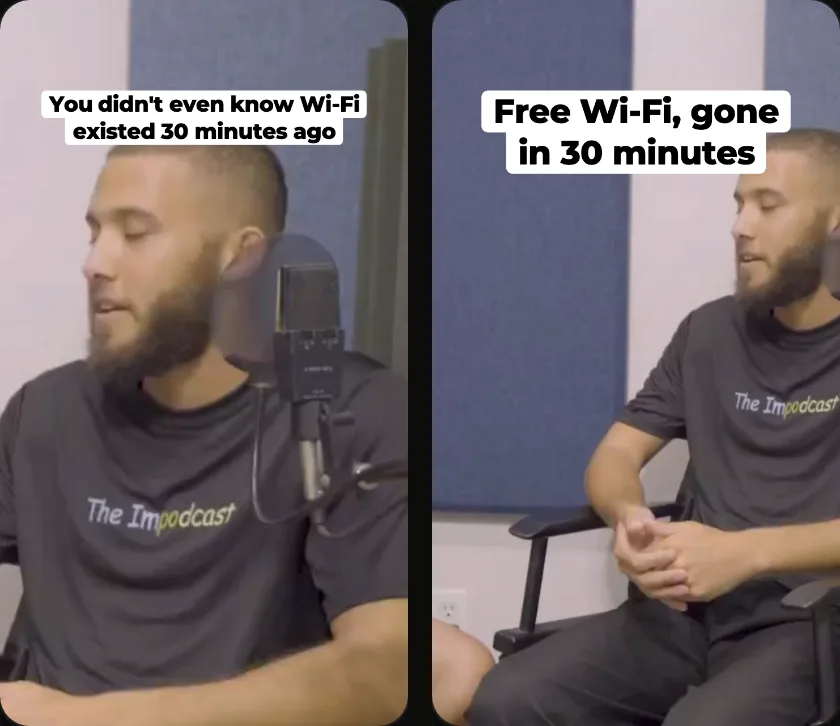
The result is about 19 seconds. That is short for a podcast clip, and our guide to clip length explains why most of ours sit between 30 seconds and a minute and a half. But length is not the goal in itself. A clip should be as long as its point and no longer, and this point is short.
We did not post either version, so we can’t tell you which would win. That is the honest state of it: a re-cut is a better bet, not a guarantee, and the numbers on the new post are what tell you.
When the cut is fine and something else is wrong
Sometimes the clip is tight and it still sits there. A few things are worth checking before you re-cut it a third time.
Nothing moves on screen. A still cover with a waveform asks a lot of a stranger. One podcaster in the same r/podcasting thread put it bluntly:
“When we first started, I just posted standard audiograms across social media channels and they did...poorly.”
If you have video, use it. If you only have audio, give the frame something to read: big captions, the hook title, a picture that matches what is being said. Our guide to adding pictures to podcast clips covers where to get images you are allowed to use. Even on video, a small change of framing early on helps, as another reply pointed out:
“putting some sort of edit like a zoom in/out within the 1st 5 seconds greatly improves retention.”
Your show is niche. A clip from a show about one specific thing will not reach millions of people, and that is not a failure of the clip. A thousand views from people who care about the subject can be worth more than a hundred thousand from people who never will.
“So just saying make an interesting clip with immediate hook is fine but that isn’t getting to a million views without a whole lot of other factors.”
It went to the wrong app. The same clip can do nothing on one app and fine on another. If it flopped on TikTok, try it as a Short or a Reel before you rework it.
What not to do
- Don’t delete it the same day. You lose the numbers that tell you what to fix, and some clips pick up after a slow start.
- Don’t repost the identical file and hope. If nothing changed, there is little reason for a different result.
- Don’t judge it against a viral clip. Judge it against your own usual. That is what tells you whether this one underperformed.
- Don’t change five things at once. Change the opening first, because that is where most clips are lost. Then you know what helped.
Re-cutting a clip in Slice, step by step
- Give it a few days, then open the numbers
On YouTube look at how many people chose to watch it versus swiped away. On Instagram, the skip rate. On TikTok, the average watch time. Compare against your own other clips, not someone else’s viral one.
- Find the second where people leave
If most people go in the first two seconds, the opening is the problem. If they stay a while and then drift, the clip is too long or the point comes too late.
- Re-cut the copy, not the original
In Slice, open the clip and use Trim to move the start to the first word that matters and the end to the line that lands. The original clip stays as it was.
- Rewrite the hook title
Open Hook. Shorter, in the speaker’s own words, and only promising what the shorter clip now pays off.
- Post the new version as a new post
Export it, post it as a fresh video, and give it the same few days before you judge it.
For the opening itself, our guide to writing the first line of a podcast clip goes into what makes a good first second and a good hook title.
Questions
Should I delete a podcast clip that got no views?
Usually not. A quiet clip costs you nothing by sitting there, and deleting it removes the numbers you need to learn from it. Fix it, post the fixed version as a new post, and leave the old one alone.
Can I repost the same clip?
Posting the exact same file again rarely changes much. Posting a changed version, with a different first second, a different length or a different title, is a new attempt, and it is the change you are really testing.
How long should I wait before deciding a clip flopped?
A few days. Short videos are shown to small groups first and can pick up later. If after a week it has fewer views than your usual clip and most people left in the first seconds, treat it as a flop and re-cut it.
What is a good skip rate or swipe rate?
None of the platforms publishes a target. YouTube’s own advice is to compare your Shorts with each other rather than with a viral hit. Your own average is the benchmark that matters.
My clips get views but nobody listens to the full episode. Is that a flop?
It is a different problem. The clip did its job of being watched; it just gave nobody a reason to go further. Say what the full episode is about in the post text, and clip moments that open a question the episode answers.